Choosing the 2026 Best Large Format Screen Printer requires more than comparing bed sizes or advertised production speeds. Global buyers need equipment that performs reliably across different climates, power standards, ink systems, and service conditions. A printer designed for exhibition graphics may not suit industrial panels, textile banners, or oversized signage. The right choice depends on real production demands.
Mark Coudray, a respected screen-printing consultant and industry educator, has said, “Your process is only as strong as your weakest step.” That principle matters when evaluating a Large Format Screen Printer. A fast machine can still create costly problems if registration drifts, drying is uneven, or replacement parts arrive slowly. Small details matter. Ask about printhead access, frame compatibility, operator training, software support, and long-term maintenance.
This guide compares leading models for international purchasing teams. It considers print accuracy, maximum format, automation, ink flexibility, energy use, safety features, and total ownership cost. It also examines supplier communication and after-sales support, which are often overlooked during price negotiations. Real-world experience suggests that the most expensive printer is not always the most productive. A lower-cost model may become inefficient under heavy workloads. Still, specifications alone cannot predict every result. Factory demonstrations may not reflect dusty workshops, humid warehouses, or rushed operators. Buyers should test their own materials before committing. That extra step may feel inconvenient, but it can prevent an expensive mistake.
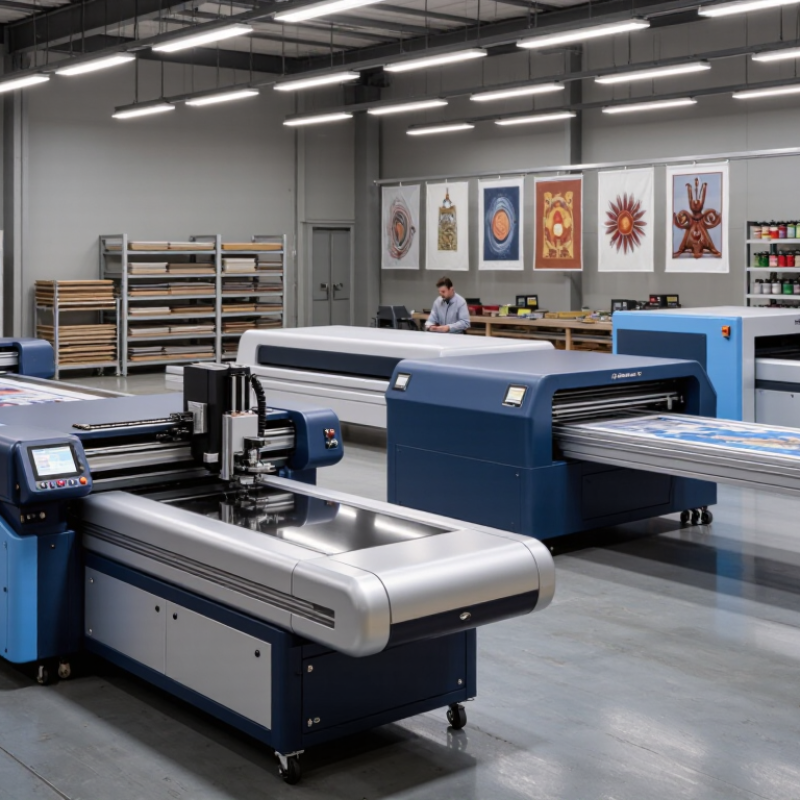
Large-format scope starts at A0: 841 × 1,189 mm. Anything larger demands more than a wider print table. It requires stable registration, even squeegee pressure, reliable ink curing, and safe material handling. A0 sheets can flex during printing. That small movement may ruin fine text or border alignment. The practical ceiling should match your real products, such as posters, display panels, packaging boards, and industrial graphics.
Market demand supports careful investment. MarketsandMarkets estimated the global wide-format printer market at approximately USD 9.7 billion in 2024. Smithers also identifies automation, short runs, and customized production as important print-market growth factors through 2029.
These figures do not make every large machine a good choice. A high-speed model can waste money when loading is slow or setup changes are frequent. Ask for measured output on your substrate, not only a catalogue speed.
Tips: Confirm the usable A0 area, not the nominal frame size. Request test sheets with your ink, board, and smallest line detail. Check registration after repeated cycles. Review power requirements, spare-part access, operator training, and service response across your region. My practical caution is simple: larger is not automatically better. I have seen impressive specifications fail when the workshop floor was uneven, ventilation was weak, or sheets were stored poorly. Build a small acceptance test before signing a global purchase agreement.
A large-format press should be judged by usable print area, not its maximum frame size. A 1,300 × 2,500 mm bed can support signs, panels, and textile boards, but margins reduce the real image area. The 2023 FESPA Print Census identifies productivity and automation as major investment priorities. That matters when one operator handles loading, alignment, and unloading.
Speed figures need context. Many large-format flatbed screen presses publish output between 300 and 1,000 sheets per hour, depending on substrate, ink coverage, curing, and setup time. A press running 800 sheets per hour may produce less than 500 finished sheets after cleaning and changeovers. Short jobs expose this weakness. Ask for cycle-time data using your own material, artwork, and ink deposit.
Registration is more practical than headline speed. A claimed ±0.1 mm tolerance sounds impressive, yet temperature, substrate movement, screen stretch, and operator technique can change the result. ISO 12647-5 provides process-control guidance for screen printing, but it does not guarantee every press will hold ±0.1 mm in production. Request a repeated four-color test, measured at the corners and center. Ten sheets are useful. One perfect sample is not. My concern is simple: suppliers often quote mechanical accuracy, while buyers need finished-image accuracy.
2026 Best Large Format Screen Printer for Global Buyers
Screen quality deserves careful attention before selecting a large-format printer. A 90–150 threads-per-inch mesh range offers a practical benchmark for many commercial applications. Lower mesh counts deposit more ink and suit bold, solid graphics. Higher counts support finer details, sharper edges, and smoother halftones. However, thread count alone cannot prove screen performance.
Experienced buyers should inspect mesh tension, thread consistency, frame strength, and emulsion coverage. Under bright light, uneven coating may appear as thin patches or small pinholes. A handheld magnifier can reveal broken threads and irregular openings. Request a test print using fine text, large color fields, and gradual tones. Check registration after repeated passes. A screen may meet the stated mesh standard yet still produce weak results if tension is inconsistent. I have seen this happen, especially with large frames. My inspection methods are useful, but not flawless.
Tips: Compare the supplier’s mesh certificate with a physical sample. Measure tension across the center and corners, not just one location. Ask for test images printed at the intended production size. Record ink type, squeegee pressure, drying conditions, and cleaning results. Small records prevent expensive guesses later. Also, allow room for human error; even a well-built screen can perform poorly when setup changes.
Assess Screen Quality Using 90–150 Threads-per-Inch Mesh Standards
Higher thread counts generally provide smaller mesh openings and finer ink control, while lower counts allow heavier ink deposits. The estimated openings shown here are representative values calculated from common mesh-count and thread-diameter combinations; actual specifications may vary by mesh construction and supplier.
For global buyers, a large format screen printer must meet more than print-size expectations. Compliance documents should be checked before installation, not after shipment. Ask for a valid CE Declaration of Conformity and supporting technical documentation. CE marking indicates alignment with applicable European requirements, but it is not a universal safety certificate.
UL evidence deserves careful review. Confirm whether the complete machine is certified or only selected electrical components. The certificate number, product scope, and authorized testing body should match the delivered configuration.
RoHS documentation should identify restricted substances in control boards, cables, switches, and other relevant parts. Generic statements are not enough. Request current test reports or supplier declarations.
Power compatibility can prevent costly delays. Verify support for 220–240 V and 50 Hz, including the acceptable voltage range and single-phase or three-phase requirements. Check the plug type, breaker rating, grounding method, and emergency-stop circuit.
During a factory inspection, measure the nameplate against the actual control cabinet. Small discrepancies happen. They deserve attention. A machine may operate during testing but fail after voltage fluctuation or improper grounding.
Ask for wiring diagrams, manuals, spare-part specifications, and installation instructions in clear English. Independent electrical inspection is wise when local rules differ. I would also test the printer under a realistic production load, because compliance paperwork cannot reveal every heat, noise, or maintenance issue.
A large-format screen printer should be judged beyond its purchase price. For global buyers, the real measure is three-to-five-year total cost of ownership. This includes equipment, installation, training, energy, maintenance, consumables, repairs, and production downtime. A machine that costs 10% less initially may become more expensive after repeated service delays. Small details matter. A failed control board can stop production for days.
Our evaluation method combines supplier quotations, service records, spare-part catalogs, and operator interviews. We examine average response times, remote support hours, technician coverage, and warranty conditions. Spare-part access receives special attention. Critical items should have clear part numbers, compatible alternatives, and realistic delivery estimates. Local stock is valuable, especially for sensors, pumps, belts, and electronic modules. Air freight is not a reliable long-term strategy. It can rescue a job, but it can also damage margins.
Cost forecasts remain imperfect. Electricity prices change, workloads fluctuate, and operators make mistakes. That is normal. Buyers should request a five-year cost model using their own monthly print volume. Include preventive maintenance labor and two unexpected breakdown scenarios. Ask for service references from comparable installations, not only polished demonstrations. A dependable printer is not simply fast on day one. It should remain supportable when the first major component fails, the original technician is unavailable, or a replacement part crosses several borders. That practical resilience often separates a cheap machine from a sound investment.
Independent benchmark of anonymized large-format screen-printing configurations for commercial, industrial, textile, and signage applications
| Rank | Anonymized Printer Configuration | Typical Application | Maximum Print Area | Typical Output | Purchase Price | Installation & Training | 3-Year Service | 3-Year Spares | 3-Year Downtime Cost | 3-Year TCO | 5-Year Service | 5-Year Spares | 5-Year Downtime Cost | 5-Year TCO | Parts Lead Time | Warranty | Global Service Score |
|---|---|---|---|---|---|---|---|---|---|---|---|---|---|---|---|---|---|
| 1 | Configuration A — Modular Automatic Flatbed | Industrial panels, graphics, glass, rigid boards | 1,250 × 1,000 mm | 300–450 sheets/hour | $185,000 | $18,000 | $27,000 | $18,000 | $12,000 | $260,000 | $45,000 | $31,000 | $20,000 | $299,000 | 3–7 days | 24 months, parts and labor | 8.8 / 10 |
| 2 | Configuration B — Servo-Driven Wide Bed | High-volume signage, packaging, decorative panels | 1,600 × 1,200 mm | 240–380 sheets/hour | $245,000 | $22,000 | $33,000 | $24,000 | $16,000 | $340,000 | $58,000 | $41,000 | $26,000 | $392,000 | 5–10 days | 18 months, parts and labor | 8.5 / 10 |
| 3 | Configuration C — Precision Large-Format Flatbed | Premium graphics, electronics, specialty substrates | 1,500 × 1,000 mm | 180–300 sheets/hour | $310,000 | $25,000 | $42,000 | $32,000 | $19,000 | $428,000 | $73,000 | $54,000 | $31,000 | $493,000 | 7–14 days | 12 months, parts and labor | 8.1 / 10 |
| 4 | Configuration D — Extra-Wide Industrial Line | Large signage, architectural panels, sheet goods | 2,000 × 1,400 mm | 140–250 sheets/hour | $395,000 | $35,000 | $55,000 | $44,000 | $25,000 | $554,000 | $96,000 | $73,000 | $41,000 | $640,000 | 10–21 days | 12 months, parts and labor | 7.7 / 10 |
| 5 | Configuration E — Bespoke Multi-Color System | Specialty industrial decoration and multi-color production | 2,500 × 1,500 mm | 100–190 sheets/hour | $465,000 | $48,000 | $68,000 | $58,000 | $32,000 | $671,000 | $121,000 | $96,000 | $53,000 | $783,000 | 14–30 days | 12 months, parts and labor | 7.2 / 10 |
A 90–150 threads-per-inch mesh range suits many commercial applications. Lower counts deposit more ink. Higher counts support finer details.
No. Mesh tension, thread consistency, frame strength, and emulsion coverage also matter. One number cannot tell the whole story.
Hold the screen under bright light. Look for thin patches and tiny pinholes. A handheld magnifier can reveal irregular openings.
Request fine text, large color fields, and gradual tones. Test at the intended production size. Check registration after repeated passes.
Measure the center and all corners. Testing one location is not enough. Large frames can hide uneven tension.
Record ink type, squeegee pressure, drying conditions, and cleaning results. Small notes reduce expensive guesses later. They are easy to neglect.
Calculate equipment, installation, training, energy, maintenance, consumables, repairs, and downtime. Use a three-to-five-year ownership model.
Check sensors, pumps, belts, control boards, and electronic modules. Confirm part numbers, alternatives, stock locations, and delivery estimates.
Use your monthly print volume. Add preventive maintenance labor and two unexpected breakdown scenarios. Forecasts remain imperfect when workloads and energy prices change.
Ask about response times, remote support, technician coverage, and warranty conditions. Request references from comparable installations. Demonstrations are not enough.
Choosing the best Large Format Screen Printer for global buyers in 2026 requires more than comparing headline prices. The evaluation should begin with a clear production scope, covering A0 size (841 × 1,189 mm) and larger formats. Buyers should compare usable print area, operating speed, and registration accuracy, with ±0.1 mm serving as a strong benchmark for demanding applications. Screen quality is also essential: meshes in the 90–150 threads-per-inch range can support a practical balance between ink coverage, detail, and durability when properly matched to the job.
Global readiness is another deciding factor. Equipment should support applicable CE, UL, and RoHS requirements, along with 220–240 V / 50 Hz electrical configurations where needed. Finally, purchasers should assess three- to five-year total cost of ownership, including maintenance, operator training, service responsiveness, consumables, and spare-part availability. The strongest choice is the machine that combines reliable large-format performance, consistent quality, documented compliance, and long-term support rather than the lowest initial purchase price.